

How to Make Yard Signs Harder to Steal
Yard sign theft happens every election cycle. Both parties. Every district size. Every state. It’s not a sign your campaign is struggling. It’s a sign your signs are visible and your candidate is generating enough of a reaction that someone is willing to risk a misdemeanor charge to remove them.
Most people searching this question are in one of two situations. Their yard sign was just stolen and they want to know what to do right now. Or they want to prevent it from happening in the first place. This post covers both, in that order: what to do after a theft, why theft happens, and what actually works to slow it down.
Is it Illegal to Steal a Political Yard Sign?
Stealing a political yard sign is generally considered theft and can result in fines or criminal charges depending on state and local laws. Most states classify it as misdemeanor theft. Trespassing on private property to take a sign adds a second charge on top of the theft. The specific penalties vary by state, but the pattern is consistent:
-
Fines up to $1,000 per sign in most states, with some states reaching $2,500 per sign under election-specific statutes.
-
Jail time up to 90 days per offense in most jurisdictions.
-
Each sign is a separate offense. Someone who pulls 10 signs in one night can face 10 separate misdemeanor counts. In states that allow prosecutors to aggregate theft values, a single night of organized removal can cross the felony threshold.
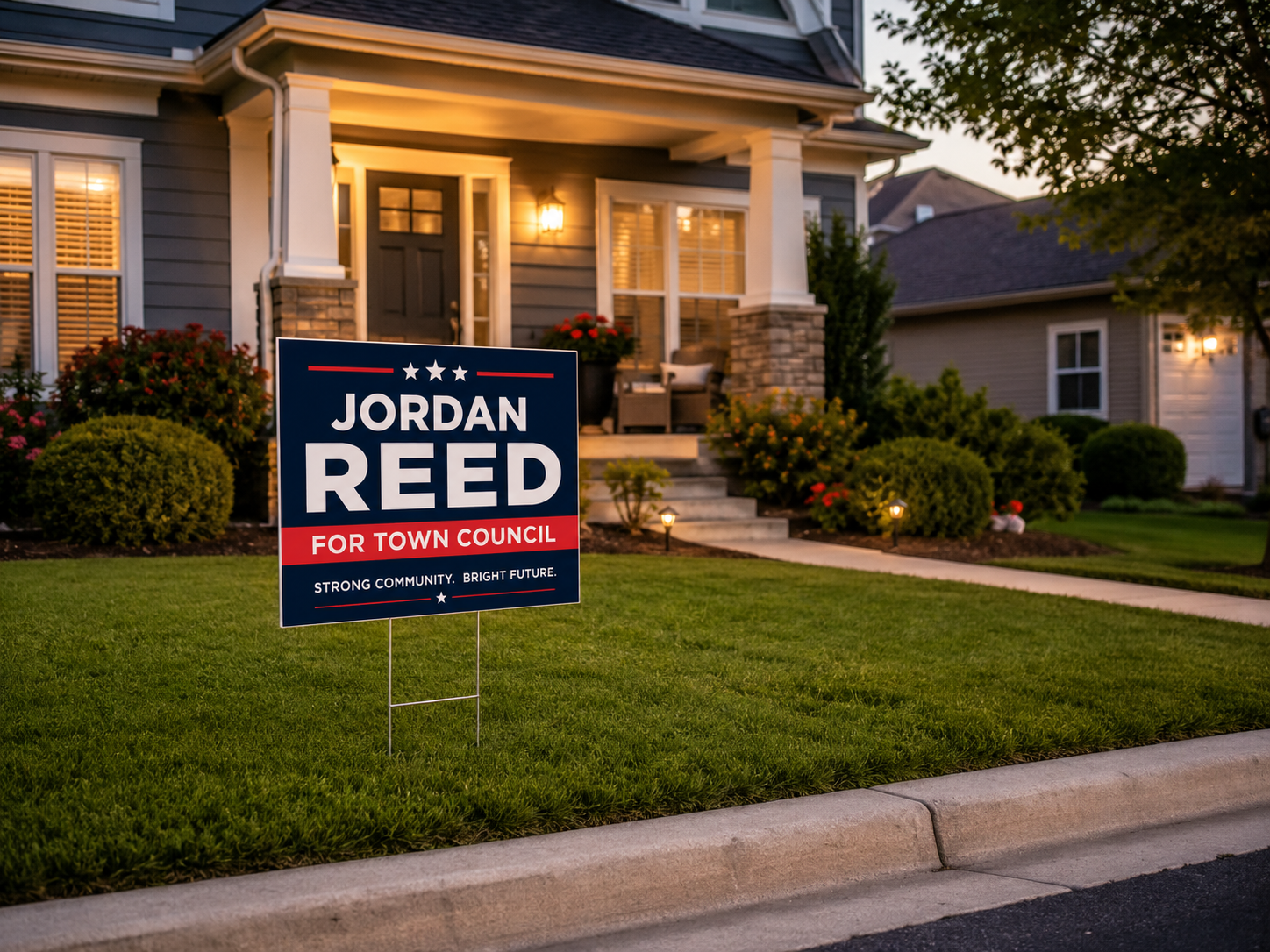
The theft also compounds with trespass. Walking onto private property to remove a sign is criminal trespass in addition to the theft charge, which is its own separate misdemeanor in every state.
For a full breakdown of what’s legal and illegal around yard sign placement, see our guide to yard sign placement laws and regulations.
Does Filing a Police Report Actually Help?
Honestly, prosecutions for individual sign thefts are rare. Police prioritize it low and without strong evidence, cases rarely go anywhere. But filing still matters for three reasons.
-
It creates a record. When theft is systematic, accumulated reports make the pattern documentable and increase the chance of police patrols in affected areas.
-
It supports the campaign’s theft tracking. Field teams use report data to identify chronic problem locations and prioritize replacement there first.
-
It matters for campaign finance. Signs are campaign expenditures. A theft record supports reimbursement documentation and can be cited in campaign communications.
Call the non-emergency line, give them the date, time, address, and approximate sign value, and keep the case number.
Your Yard Sign Was Just Stolen — Do These Three Things First
-
Document Before You Replace
Before pulling the empty stake out of the ground, photograph it. Photograph the disturbed soil around it. Note the time you discovered it missing. This takes 60 seconds and turns an empty yard into usable documentation for a police report, campaign theft tracking, and any insurance claim if signs represent significant campaign expenditure.
-
Report It, Then Tell the Campaign
File with the non-emergency police line first, then contact the campaign’s field office. Don’t just reorder a replacement yourself without notifying the field team. Good campaigns track theft by location. If your corner has been hit twice, the field director needs to know that before deciding whether to send a standard sign or upgrade the staking method.
-
Stolen Signs Can Work in Your Favor
This is documented campaign strategy, not optimism. Campaigns & Elections Magazine has written specifically about how to use sign theft to generate earned media, recruit volunteers, and raise small-dollar contributions. The mechanism is straightforward.
Angry supporters are the easiest volunteer ask you’ll ever make. A supporter calling to report a stolen sign is already motivated and already engaged. That call is the moment to ask if they want to do more than hold a sign. On social media, a calm post framed around free speech (not attacking the opposition) consistently generates new sign requests and donations that exceed the cost of what was stolen. The sign that gets stolen often creates more value than the one that stays up.
Why Signs Get Stolen & How That Changes What You Should Do About It
Most yard sign theft is opportunistic, not organized. That’s not an assumption. It’s what police departments consistently report when they describe sign theft patterns. Understanding the difference is the most important thing in this guide, because the tactics that work against opportunistic theft do almost nothing against organized removal, and vice versa.
Opportunistic vs. Organized Removal
|
Type |
What it looks like and how to respond |
|
Opportunistic |
One person, driving or walking past, sees a sign they dislike and an H-stake that pulls out in three seconds. |
|
Organized |
Multiple signs disappear from different locations the same night, often in a pattern, stakes sometimes left behind. |
Signs That Get Targeted First
The profile of a high-theft sign is consistent across campaigns and districts:
-
Single, isolated placement with no nearby signs from the same campaign
-
Right at the curb edge, reachable from a slowing vehicle
-
No outdoor lighting within 20 feet
-
Left unmonitored for more than 48 hours at a time
Every item on that list is fixable. The sections below address each one.
When Theft Spikes During a Campaign
Theft increases sharply in the final two to three weeks before election day and peaks the nights immediately before and on election day itself. The bulk of it happens between 10 pm and 2 am. This timing matters practically: a supporter on a quiet residential street who brings their sign inside each evening during the final two weeks will almost always still have it. A corner lot sign on a high-traffic road during that window should be treated as disposable. Price in the replacement cost and keep spares on hand.
Staking Methods That Make Signs Harder to Pull Out
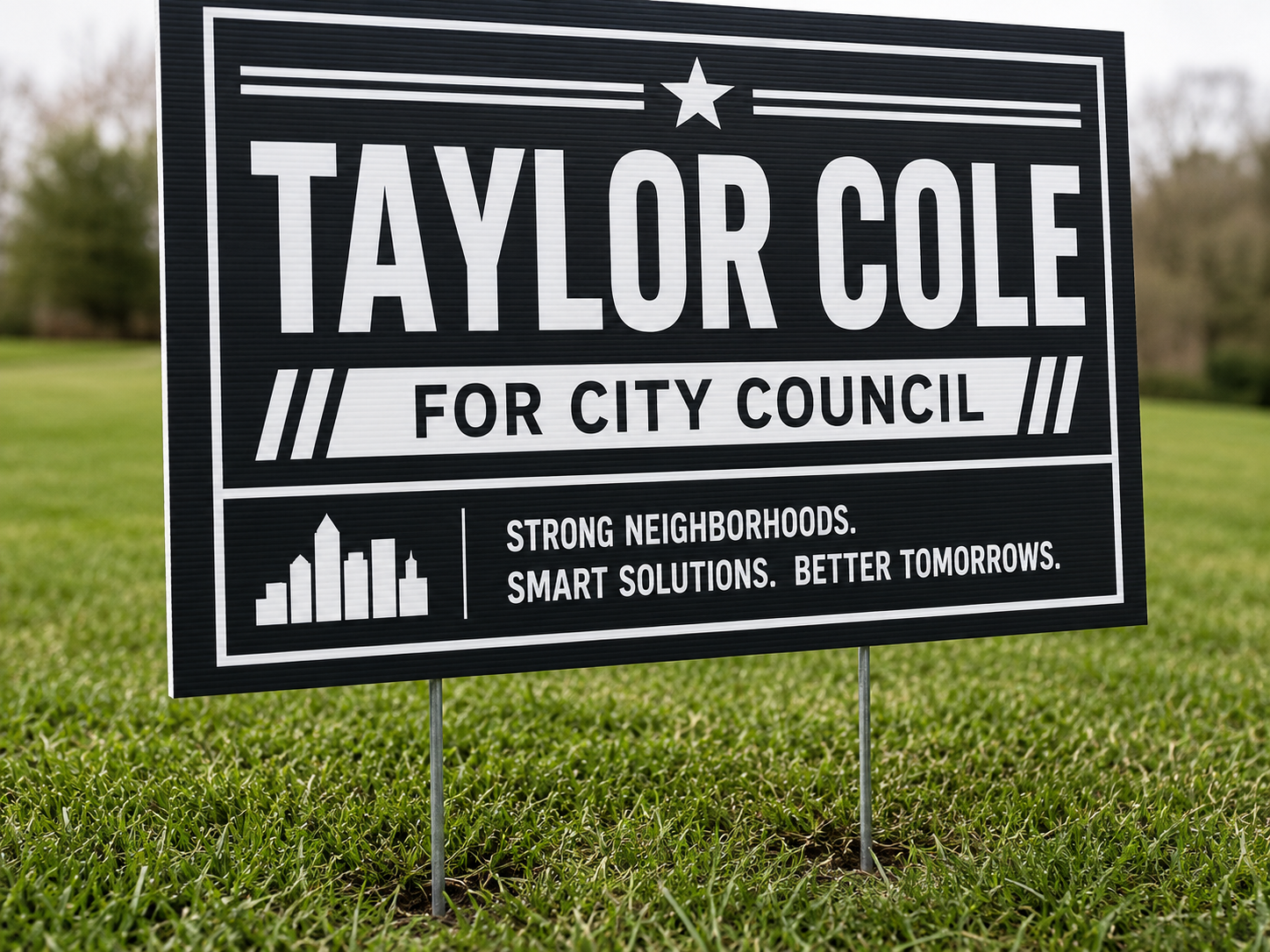
The standard H-wire stake is designed for fast volunteer installation, not resistance to removal. A sign with a default-depth H-stake pulls out in under five seconds with one hand. Three upgrades change that significantly, in order of effort and cost.
Drive Stakes Deeper Than the Default
Standard installation buries 6 to 8 inches of stake. Double it to 12 to 14 inches. A sign with 14 inches of stake in firm soil requires sustained effort to extract. It won’t come loose with a quick tug from a pedestrian or a hand reaching from a slowed vehicle. This single change, applied consistently, eliminates the fastest category of opportunistic theft. For the full installation method including soil types and tools, see our guide to securing yard signs in the ground.
Use Two Stakes Instead of One
A coroplast sign has multiple vertical flute channels. Threading a second H-stake through a second channel prevents the sign from rotating or torquing free with a single-hand pull. Removal now requires both hands working in coordination on two separate points simultaneously. Two wire stakes at 12 to 14 inches each in firm soil is the single most effective low-cost deterrence upgrade available. It adds about 90 seconds to installation per sign and meaningfully changes the removal difficulty for any opportunistic thief.
Rebar and Zip Ties for Repeat-Theft Locations
For locations that have already lost two or more signs: drive a piece of rebar into the ground first, then zip tie the sign to it. The sign can still be cut loose with a knife, but the rebar roots the setup in a way H-wire doesn’t and signals to anyone approaching that this sign was installed with more intention than the last one. Rebar costs about $2 per stake. For chronic problem corners, it’s the most cost-effective upgrade on this list.
Placement Decisions That Reduce Theft Risk
Where a sign goes determines how often it gets taken as much as how it’s staked. Two signs with identical hardware will have very different theft rates depending on placement.
Line-of-Sight to the House Changes the Calculation
A sign clearly visible from a living room window or front porch gets stolen less often than one in a dark corner of the yard. The casual opportunistic thief is making a fast risk assessment. Lighting and proximity to an occupied house introduce uncertainty. They’re not willing to risk being seen through someone’s window at 11pm for a yard sign. This isn’t about catching anyone. It’s about being a less appealing target than the sign down the street.

Set the Sign Back From the Curb
Moving a sign 10 to 15 feet back from the curb edge changes the entire removal equation. A sign at the curb can be grabbed from a vehicle that barely slows down. A sign set back into the yard requires the person to stop, get out, walk onto private property (adding criminal trespass to the existing theft charge), spend 20 to 30 seconds dealing with the stake, and walk back. Each of those additional seconds is time the neighbor’s porch light might come on, a dog might bark, or a passing car might slow down. Most opportunistic thieves won’t take that risk for a yard sign.
Cluster Signs at Supporter Properties When You Can
A single sign is a low-stakes target. A block where four supporters each display one is a different calculation entirely. Multiple stops, more time on multiple properties, more exposure to neighbors. Campaign field teams that build density in friendly precincts see lower per-sign attrition than campaigns that spread placements thin. It requires more canvassing upfront but pays off in reduced replacement costs over the campaign.
Treat High-Traffic Corner Lots as a Rotation
Corner lots are the highest-visibility locations in any district and the highest-theft locations. The right mental model: don’t try to make a corner sign theft-proof. Make it easy to replace. Keep spares designated for your top five corners, check them every 48 hours during the final three weeks, and price replacement into your sign budget from the start. A corner that stays covered through election day via two or three replacements outperforms a corner you abandoned after the second theft.
For campaign-specific placement strategy, see our campaign sign ideas and placement strategy guide.
How to Stop People From Stealing Political Signs
A Camera Notice Is the Most Practical Low-Cost Deterrent
A weatherproof notice near the sign stake reading “Property monitored by security camera” costs almost nothing and changes the decision for the person making a three-second impulsive choice. It introduces uncertainty. Against organized removal, it does nothing. But organized removal is the minority of the problem. The casual person who dislikes a sign and sees an unmonitored yard is the majority. A camera notice addresses that majority directly.
A Trail Camera at a Chronic Problem Location
For supporters who have had signs stolen repeatedly from the same property, a trail camera positioned visibly near the sign serves two purposes. It creates usable documentation if theft happens anyway. And the visible camera hardware (not hidden, not disguised) functions as a deterrent signal to anyone approaching. A Springfield couple used an Apple AirTag inside their sign to track a thief to their address and recover a batch of stolen signs. At around $30, it’s a reasonable investment for any location that’s been hit three or more times.
Three Popular DIY Tactics to Avoid
The three most Googled anti-theft tactics for yard signs all share the same problem: they create liability exposure for the property owner, not just friction for the thief.
-
Fishing line trip wires. A line at ankle height across a yard that trips a mail carrier, a neighbor’s child, or an emergency responder is a premises liability lawsuit. The fact that it was meant for a sign thief is not a defense.
-
Vaseline or grease on the sign back. Mostly ineffective because thieves pull signs by the stake, not the face. If it causes someone to slip and fall on your property, you’re exposed regardless of intent. One Massachusetts man’s fake “Danger” wired sign triggered a state bomb squad response.
-
Electric fences around signs. Require permits in most jurisdictions, are illegal in some, and contacting a person with one, even unintentionally, can be classified as assault depending on state law. Consult local ordinances before considering this in any form.
Building a Replacement System That Keeps You Covered
At some point deterrence gives way to logistics. Some locations cycle through signs regardless of staking method or placement. The campaigns that manage theft best don’t treat replacement as a crisis. They treat it as a planned operational reality with a system behind it.
Order Ahead With Attrition Built In
Order 20 to 30 percent more signs than your initial placement target. That buffer covers theft, weather damage, last-minute supporter requests, and volunteer placement errors without triggering emergency reorders. Emergency reorders are both slower and more expensive than planned orders. For cost guidance on larger quantities, see our bulk yard sign pricing guide.
The 48-Hour Replacement Rule
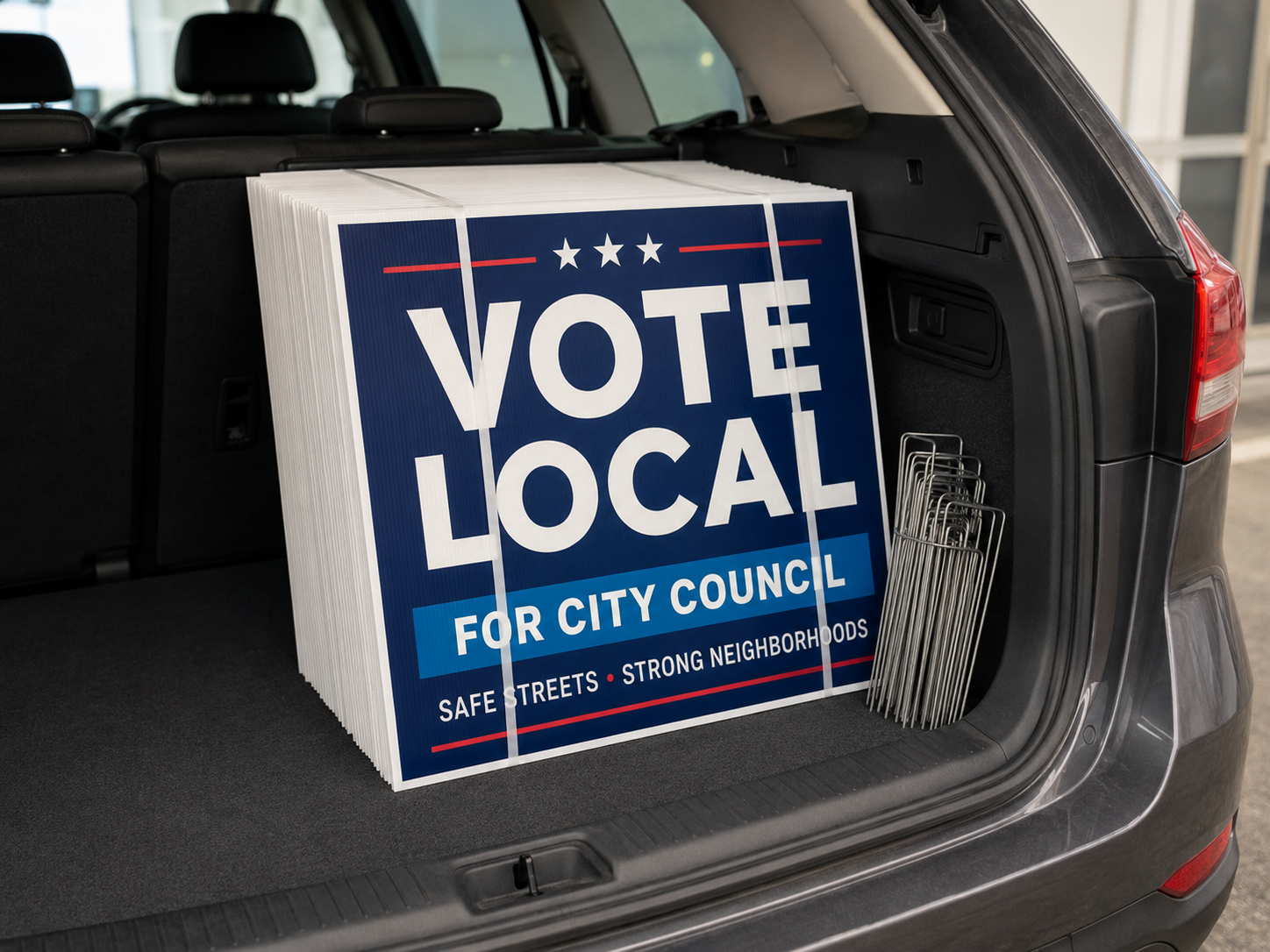
The most important variable in managing theft isn’t how often signs get taken. It’s how fast they get replaced. A corner that goes dark for a week loses more cumulative impressions than five individual stolen signs replaced within a day each. Build a simple system:
-
A designated box of spare signs in a campaign vehicle or at the field office
-
A replacement route driven every 48 hours during the final three weeks
-
A text channel supporters can use to report missing signs immediately
Speed is the metric. Not prevention rate.
Know When to Stop Contesting a Location
Some locations cycle through signs every few days regardless of tactics. The math: if a sign costs $8 and gets stolen every three days, that’s roughly $80 per month to hold one corner. At some point the inventory and volunteer hours are worth more redirected to adjacent residential properties where supporters actually live. Residential supporter yards have dramatically lower theft rates than public-facing corner placements. The signs that stay up longest are in the yards of people who care about them.
Yard Sign Theft Prevention Checklist:
-
Drive stakes deeper
-
Use two stakes instead of one
-
Move yard signs farther from the curb
-
Place signs in well-lit areas
-
Keep replacement yard signs ready
-
Report thefts to the campaign
Replace Stolen Signs Fast With Yard Sign Plus
If you’re heading into campaign season and signs are disappearing, the most effective response is having enough inventory to replace fast without going dark. Our political yard signs are fully custom, printed in full color, and backed by a free proof in about one hour. No minimums, no setup fees, and no hidden charges at checkout. Rush production is available, and expedited shipping gets replacement signs moving the same day an order is approved.
Not sure what size to reorder? See our political yard sign size guide. Whether you’re replacing one sign from a residential yard or restocking 200 across a district, see our political yard signs page to get started. For turnaround times and shipping options, see our shipping information page. For larger orders, our bulk order program covers tiered pricing across any quantity.





Leave a Comment